How to Choose a Website Design Service for Small Business
Searching for the best website design service for your small business? Use this checklist to choose the right partner and avoid expensive redesign cycles.
Choose a small business website design service by comparing relevant work, content responsibilities, mobile usability, technical SEO, ownership terms, and post-launch support. Ask each provider to quote the same scope and explain how visitors will become inquiries or customers. The right partner fits your budget and operating needs, not just your preferred visual style.
Why Most Small Business Websites Fail to Convert
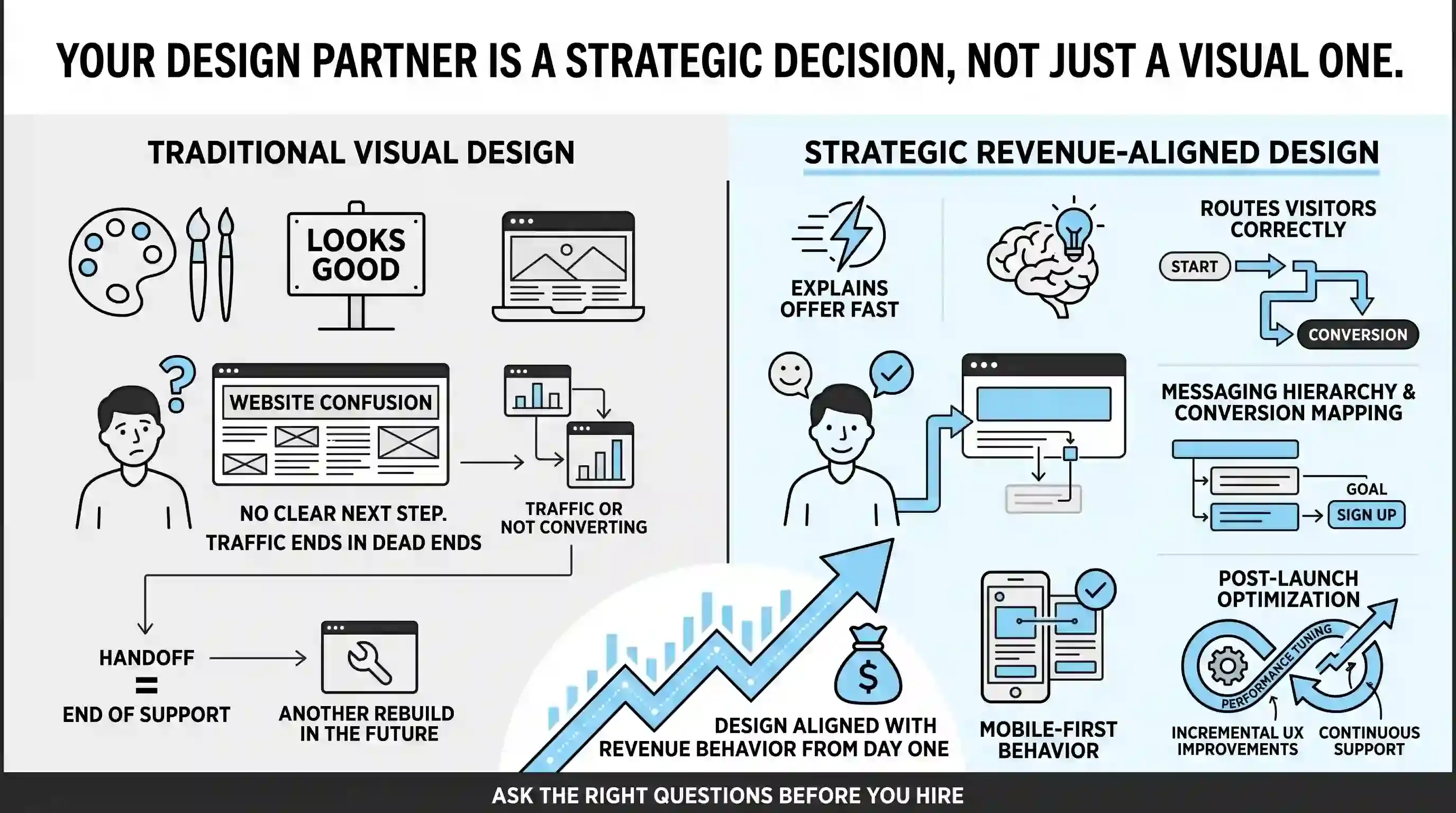
Most small businesses do not fail online because of a lack of traffic. They fail because their website does not explain the offer fast enough or route visitors to the right next step.
That is why selecting a design partner is a revenue strategy decision, not just an aesthetic one.
Conversion rates vary by industry, traffic source, and what counts as a conversion. Rather than treating a generic benchmark as a target, define the action that matters to your business and measure your own baseline before evaluating a redesign.
- Visual-only studio: Looks polished but often leaves value unclear, increasing bounce rate.
- Strategy-first partner: 5-second clarity, direct CTAs, strong mobile speed, and cleaner lead capture paths.
Things to Look for Before Hiring a Web Design Service
1. Messaging Hierarchy and First-Impression Clarity
Visitors decide quickly whether to trust a business. If your homepage uses vague slogans instead of clearly stating what you do, who you serve, and why it matters, many users leave immediately.
- What to ask for: Ask how they run a 5-second clarity test so the offer and primary CTA are visible above the fold.
2. Intentional Conversion Mapping
A high-performing website behaves like a focused sales funnel. Each page should have one primary goal, such as booking a call, requesting a quote, or submitting a lead form.
- What to ask for: Ask how they map user journeys before development and how they reduce form friction.
3. Mobile Performance and Modern Technical Stack
More than half of global web traffic is mobile, yet many sites still underperform on phones because of heavy page builders and weak layout decisions.
- Speed penalty: If mobile pages take too long to load, abandonment rises sharply and conversion rates drop.
- What to ask for: Confirm they use performance-focused frameworks like Next.js or clean server-rendered architecture rather than bloated template stacks.
4. Post-Launch Optimization and Support
Launch is the beginning, not the finish line. Performance tuning, form analytics, and iterative UX improvements are where sustained growth usually happens.
Key rule: If support ends at handoff, you are likely paying for another expensive rebuild sooner than expected. The best website design service aligns design decisions with long-term revenue behavior from day one.
Comparison: Generic Designer vs. Strategy-First Agency
| Evaluation Criteria | Generic or Template Web Designer | Strategy-First Web Partner |
|---|---|---|
| Primary Goal | Deliver a visually attractive site. | Drive qualified leads and business revenue. |
| Messaging Approach | Uses placeholder copy or unoptimized headlines. | Builds a clear messaging hierarchy with direct CTAs. |
| Mobile Strategy | Shrinks desktop layouts to fit smaller screens. | Designs specifically for mobile touch behavior and speed. |
| Technical Stack | Heavy templates and plugin-dependent stacks. | Clean, fast code with SSR or static generation where appropriate. |
| Post-Launch Role | Delivers files and exits. | Monitors analytics, speed, and conversion performance over time. |
5 Critical Questions to Ask Before Signing a Contract
Before paying a deposit, ask prospective partners these direct questions:
- How do you test and refine messaging hierarchy so first-time visitors immediately understand our service?
- What technical framework do you use to target sub-2-second mobile load performance?
- How do you handle technical SEO and schema markup during the build phase?
- Do we retain full ownership of code, domain, design assets, and hosting accounts?
- What post-launch tuning or support packages do you provide to improve conversion rates over time?