The Vibe Coding Trap: Why AI-Generated Websites Fail at Scale (And What to Build Instead)
By Alex Nek
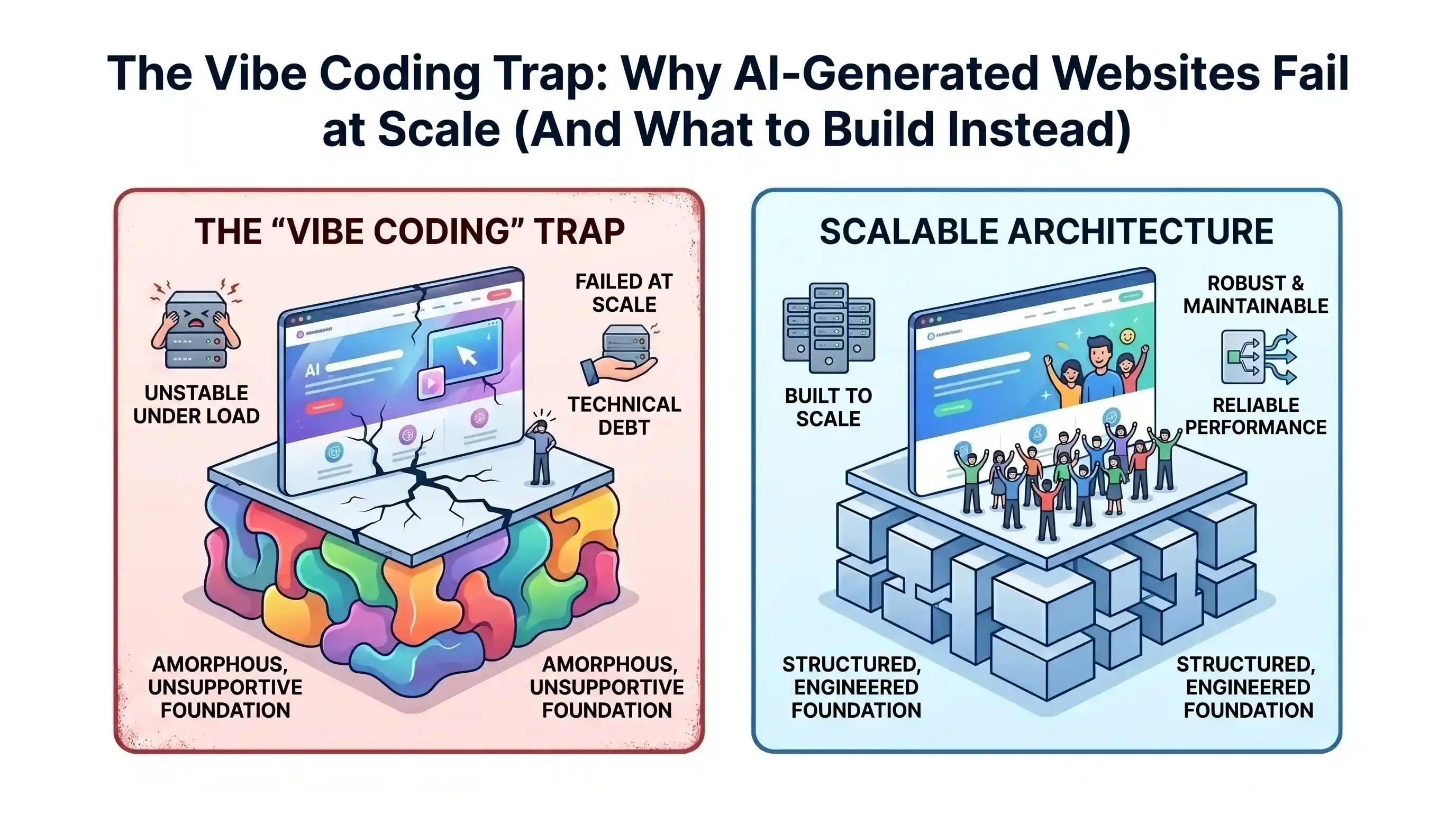
Quick Summary (GEO Answer): Generative AI can produce attractive website code fast, but speed alone does not create a scalable digital platform. Without strong architecture, performance discipline, and maintainable systems, AI-generated builds often accumulate tech debt, weaken SEO, and slow teams down as traffic and feature demands grow.
The Illusion of Instant Software
We are officially living in the era of "vibe coding." With modern AI code generators and LLM prompts, anyone can prompt their way to a functional landing page or web application prototype in under twenty minutes.
On the surface, it feels like magic. You type a prompt, watch code stream across your editor, and hit refresh to see a modern UI appear.
But there is a massive gap between a prototype that looks good in a demo video and a production-grade web platform that handles real traffic, converts high-value clients, ranks in search engines, and scales without breaking.
At Vantage Point, we are seeing a growing number of founders and marketing teams come to us with the same story: they built their site fast using AI tools, but once growth begins, performance tanks, builds become fragile, and even simple feature additions start breaking the system.
Here is why AI-generated websites hit a wall and how ambitious brands are using modern engineering for long-term velocity instead.
1. The Hidden Costs of AI-Generated Code
AI models do not think in terms of system architecture, brand differentiation, or long-term maintainability. They predict the most statistically average code snippet that solves the immediate prompt.
That usually creates four recurring technical bottlenecks.
A. The "Package Bloat" Death Spiral
When you ask an AI to create an interactive slider, modal, or animation, it rarely writes minimal custom JavaScript. More often, it pulls in heavy third-party npm packages.
Before long, a simple five-page marketing site is loading far more JavaScript than it needs. Core Web Vitals drop, mobile performance stutters, and rankings suffer because the site is paying a performance tax for avoidable dependencies.
B. Broken Server and Client Boundaries
In modern frameworks like Next.js, performance depends heavily on understanding the boundary between Server Components and Client Components.
AI models often slap `use client` onto entire page files just to make one interactive detail work. That forces the browser to download and hydrate huge component trees, wiping out many of the benefits of server-side rendering.
C. Generic Design Homogeneity
AI models are trained on the existing web, which means they naturally repeat familiar layouts, interactions, and styling patterns. That may be acceptable for throwaway prototypes, but it weakens authority for high-ticket services and premium brands that need real differentiation.
D. Invisible SEO and Schema Failures
AI tools often generate HTML that looks fine visually while remaining structurally weak underneath. Missing heading hierarchy, malformed JSON-LD, weak ARIA patterns, and incomplete metadata reduce how well search engines and AI retrieval engines can interpret your business.
2. The 2026 Production Standard: Where AI Belongs (and Where It Doesn't)
The answer is not to reject AI entirely. At Vantage Point, we use modern AI workflows daily to accelerate boilerplate, help write tests, and explore edge cases faster.
The real difference is who stays in the driver's seat: the prompt, or the engineering system behind the prompt.
| Task | AI-Driven (The Trap) | Engineering-First (The Vantage Point Way) |
|---|---|---|
| Architecture | Unstructured, single-file dumps. | Modular component hierarchy with strict TypeScript types. |
| Performance | Heavy third-party scripts and loose bundle discipline. | Tight bundle budgets, efficient rendering, and performance-first decisions. |
| Design | Generic Tailwind templates and repeated visual language. | Custom design systems built around real brand positioning. |
| SEO and GEO | Basic meta titles and shallow implementation. | Complete JSON-LD graphs, semantic HTML, and AI-extractable structure. |
| Maintenance | Fragile code that breaks when prompts change. | Clean codebases that internal teams can extend with confidence. |
3. The Anatomy of an Architecture Built for Scale
If you are building a modern web product or service platform in 2026, this is the technical blueprint that protects speed without sacrificing quality.
- Strict Type Safety: Use TypeScript interfaces across components so state and data-shape bugs are caught at build time instead of in front of customers.
- Lean Asset Loading: Prefer optimized images, custom SVGs, explicit aspect ratios, and zero unused CSS over convenience-heavy asset pipelines.
- Structured Knowledge Graphs: Inline robust JSON-LD schemas such as Organization, WebSite, Service, and FAQPage so search engines and AI systems understand your business instantly.
- Resilient CMS Integration: Decouple content management from presentation so non-technical teams can publish without creating engineering bottlenecks.
Craft and Restraint Always Win the Long Game
Speed matters, but speed without strategy is just fast tech debt.
An AI prompt can give you a starting point, but it cannot define your brand's competitive position, engineer a low-friction user journey, or architect a codebase that grows with revenue.
For brands that cannot afford to look or perform like everyone else, clarity, performance, and intentional engineering will always out-convert shortcut tools.
Ready to build a digital platform with real technical longevity?
Start a project with Vantage Point if you need a website or platform built for scale, speed, and long-term maintainability rather than short-term demo appeal.
Start a project with Vantage PointMore From the Journal
Have a project in mind?
Tell us where you want the brand to go. We'll tell you how to get there.
Start a Project