Modern JavaScript Frameworks and SEO: Next.js vs. Nuxt vs. SvelteKit vs. Astro
By Alex Nek
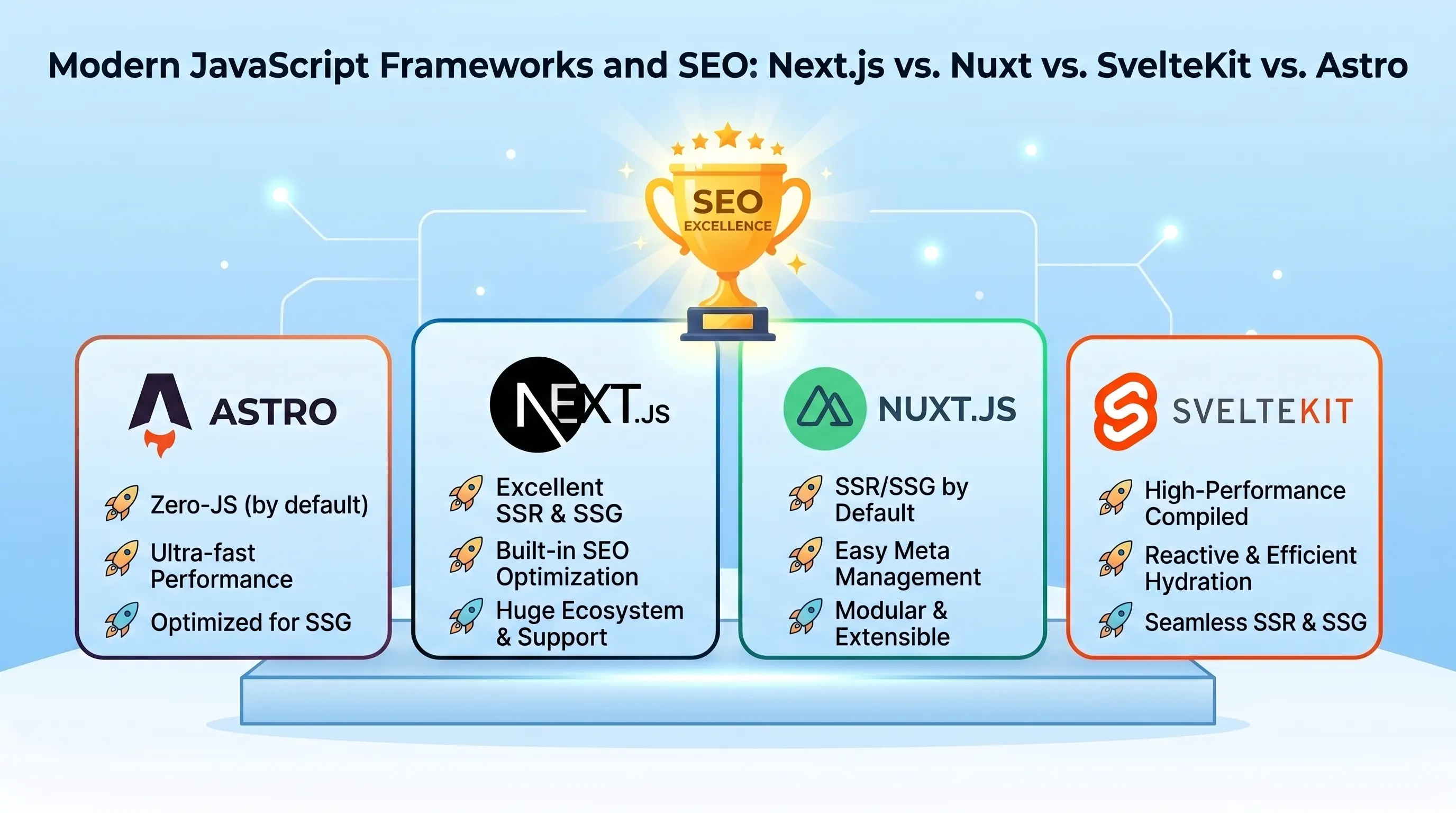
Historically, JavaScript-heavy single-page applications (SPAs) faced serious SEO limitations. Traditional client-side rendering often shipped an almost empty HTML shell and forced crawlers to execute large JavaScript bundles before discovering real content.
Modern meta-frameworks changed that model. By combining Server-Side Rendering (SSR), Static Site Generation (SSG), and selective hydration, they deliver fully rendered HTML to search crawlers immediately.
The key difference now is not whether SEO is possible, but how efficiently each framework handles rendering strategy, metadata control, and JavaScript overhead at scale.
Comparison Matrix
| Framework | Core UI Library | Primary Rendering Model | JS Bundle Footprint | Best Use Case for SEO |
|---|---|---|---|---|
| Next.js | React | Flexible SSR, SSG, and Server Components. | Moderate to Heavy powerful but can grow quickly without bundle discipline. | Large-scale web apps, e-commerce, and enterprise platforms. |
| Nuxt.js | Vue.js | Flexible SSR, SSG, and hybrid rendering. | Lightweight to Moderate typically leaner initial payloads than many React stacks. | Content-rich web apps, SaaS dashboards, and marketing portals. |
| SvelteKit | Svelte | Flexible SSR, SSG, and prerendering by route. | Very Small compiled output keeps runtime overhead low. | High-performance marketing sites and speed-critical products. |
| Astro | Framework-Agnostic | Island Architecture static-first with selective hydration. | Minimal to Zero ships little or no JS by default. | Content-focused sites, blogs, docs, and corporate marketing pages. |
Deep Dive: Framework SEO Analysis
1. Next.js (React Ecosystem)
As the dominant framework in the React ecosystem, Next.js defines many current standards for full-stack JavaScript delivery.
- SEO Strength: React Server Components can keep static content fully server-rendered, reducing unnecessary client-side JavaScript.
- SEO Strength: Built-in optimizations through next/image and next/font improve LCP and reduce layout shifts.
- SEO Strength: The Metadata API supports clean, type-safe generation of canonical tags, Open Graph data, and structured schema.
- SEO Challenge: Hydration overhead can increase INP risk on lower-end devices when React dependencies and client bundles are not tightly controlled.
2. Nuxt.js (Vue Ecosystem)
Nuxt provides one of the cleanest developer experiences for SSR and SEO workflows in the Vue ecosystem.
- SEO Strength: Nuxt SEO modules automate sitemap generation, canonical handling, robots directives, and social previews.
- SEO Strength: Composables like useSeoMeta make metadata management straightforward and maintainable.
- SEO Strength: Automatic route-level code splitting helps keep initial payloads efficient.
- SEO Challenge: The ecosystem is smaller than React's, so niche integrations may require more custom implementation work.
3. SvelteKit (Svelte Engine)
SvelteKit shifts much of the runtime burden to compile time, resulting in notably small client payloads.
- SEO Strength: Tiny compiled JavaScript and no virtual DOM runtime often produce excellent Core Web Vitals.
- SEO Strength: Lean bundles support strong LCP and interactivity performance by default.
- SEO Strength: Route-by-route prerendering decisions are well suited for mixed marketing and product surfaces.
- SEO Challenge: Smaller adoption means fewer plug-and-play SEO integrations compared with React and Vue.
4. Astro (Island Architecture)
Astro is built for content performance first, using island architecture to ship JavaScript only where interaction is needed.
- SEO Strength: Zero JavaScript by default creates extremely clean static HTML output.
- SEO Strength: Framework-agnostic composition allows React, Vue, or Svelte components while preserving a low-JS baseline.
- SEO Strength: Static-first delivery consistently drives high PageSpeed outcomes.
- SEO Challenge: Astro is less ideal for highly dynamic, state-heavy dashboard experiences than app-centric frameworks.
Architectural Summary: How to Choose for SEO
For SEO outcomes, the best framework is the one that matches your content model and interaction complexity.
- Choose Astro for content-heavy marketing websites, blogs, and docs where page speed and low JS overhead are the main ranking advantages.
- Choose Next.js for complex enterprise products and e-commerce systems that need deep React integration and broad ecosystem support.
- Choose Nuxt.js for teams that want ergonomic SEO tooling and Vue-first rendering architecture.
- Choose SvelteKit for performance-critical experiences where tiny bundles and low memory usage are top priorities.
More From the Journal


Have a project in mind?
Tell us where you want the brand to go. We'll tell you how to get there.
Start a Project