How to Make AI See Your Website: A Guide to Generative Engine Optimization (GEO)
By Alex Nek
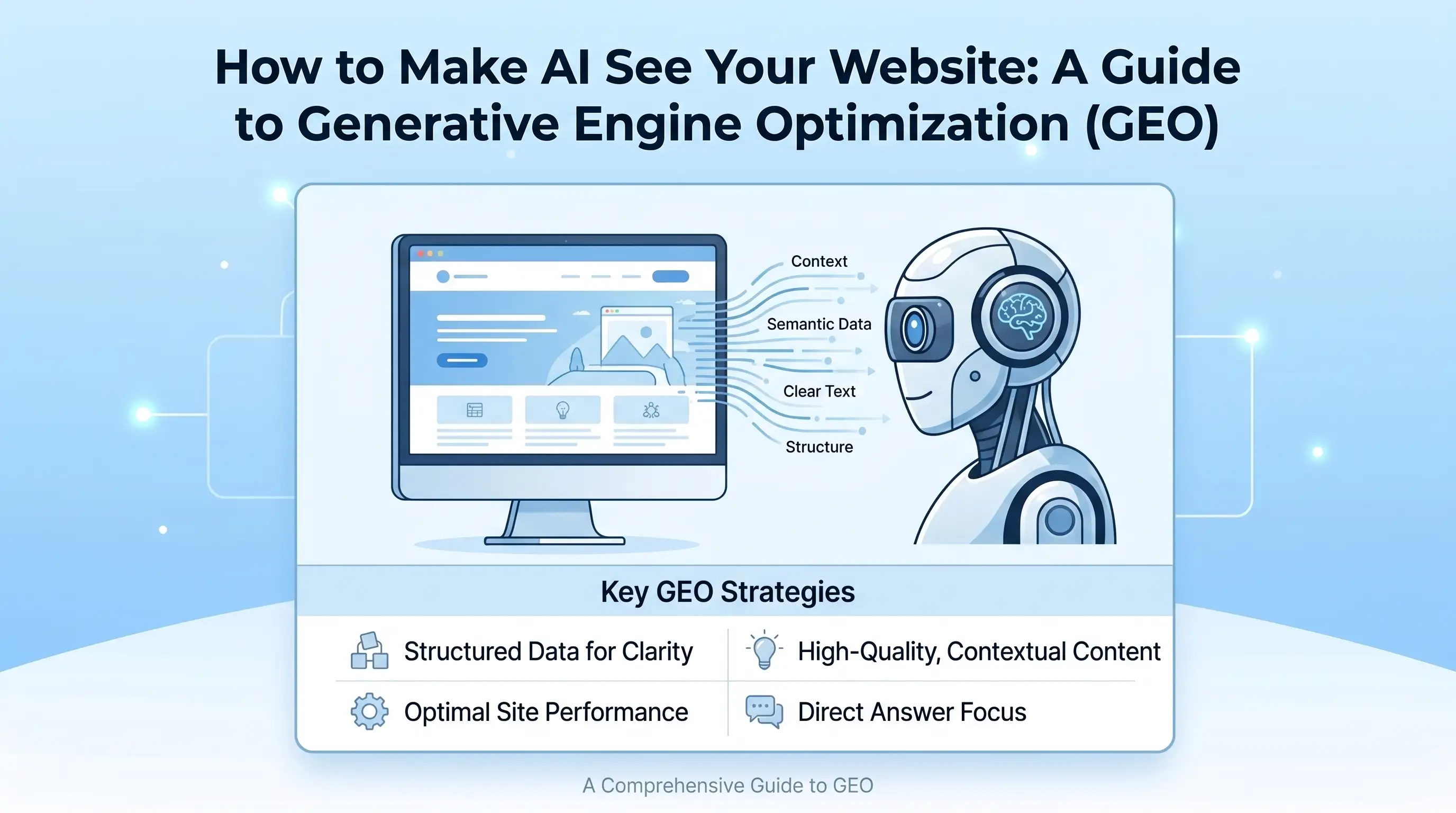
Search behavior has shifted. A growing share of users now asks conversational questions in systems like ChatGPT, Perplexity, Google AI Overviews, and Claude, then trusts a synthesized answer with citations.
If AI engines cannot crawl, interpret, or trust your website, your brand becomes invisible to an expanding segment of discovery traffic.
Moving from classic SEO to Generative Engine Optimization (GEO) and Answer Engine Optimization (AEO) requires understanding how large language models discover, retrieve, and rank source material.
Traditional SEO vs. Generative Engine Optimization (GEO)
| Dimension | Traditional SEO | Generative Engine Optimization (GEO) |
|---|---|---|
| Primary Goal | Rank on page one for specific keyword targets. | Get cited as a trusted source in AI-generated answers. |
| User Behavior | Users click through multiple result links. | Users often consume a single generated summary (zero-click behavior). |
| How Content Is Found | Keyword matching plus link authority. | Semantic retrieval, vector matching, and RAG-based extraction. |
| Content Structure | Long-form pages optimized around search intent. | Answer-first content chunks, tables, definitions, and direct statements. |
| Technical Requirements | Sitemaps, mobile responsiveness, and fast page speed. | Allowed AI crawlers, SSR/SSG HTML output, schema, and llms.txt coverage. |
1. Technical Access: Ensure AI Bots Can Crawl Your Site
Before an AI engine can cite your content, its crawler must be able to access and parse your pages. Many sites accidentally block AI crawlers at the robots or firewall layer.
Check Your robots.txt File
- Ensure robots.txt does not block key AI crawlers.
- Allow GPTBot and OAI-SearchBot (OpenAI ecosystem).
- Allow PerplexityBot (Perplexity ecosystem).
- Allow ClaudeBot and anthropic-ai (Anthropic ecosystem).
- Review Google-Extended settings for AI-overview and training controls.
Verify Security Middleware (Cloudflare and Firewalls)
Bot management and strict WAF rules frequently block legitimate crawlers. Whitelist trusted AI user-agents and validate server logs to confirm successful crawl responses.
Provide Clean, Server-Rendered HTML
LLM retrieval pipelines process raw HTML. If content is hidden behind client-only rendering, AI systems may see an incomplete page. Prefer SSR or SSG so meaningful content ships immediately in initial HTML.
Adopt the llms.txt Standard
Add an llms.txt file at your domain root to provide a concise machine-readable map of core pages, offerings, and documentation. Think of it as an AI-first complement to your sitemap.
2. Content Extraction: Format for Machine Parsing
Most AI answer systems rely on Retrieval-Augmented Generation. They pull small chunks from indexed pages, then synthesize responses. If your answer is buried, it is less likely to be selected or cited.
Use an Answer-First Structure
- Write question-based H2 and H3 headings.
- Place a direct two-to-three sentence answer immediately below each question heading.
- Follow with lists, data tables, and deeper context.
- Avoid long narrative intros before the first actionable answer.
Use High-Density Formatting
- Tables for comparisons, pricing breakdowns, and specifications.
- Numbered steps for procedures and implementation workflows.
- Bulleted summaries for key takeaways and definitions.
Implement JSON-LD Schema Markup
- Organization schema to define your brand entity and official references.
- FAQPage schema to map direct questions and direct answers.
- Article and TechArticle schema to strengthen authorship, dates, and topical authority.
3. Brand Authority: Build Entity and Trust Signals
AI systems evaluate source trust, not only topic relevance. Strong authority signals improve your odds of being cited across answer engines.
Strengthen E-E-A-T Signals
- Add visible author bios with verifiable profile links.
- Cite primary sources, original data, and reputable studies.
- Display publication dates and last-updated timestamps clearly.
Build Off-Page Entity Mentions
- Earn mentions in digital PR, industry reports, and trusted publications.
- Maintain active presence where AI engines heavily index discussion context, such as LinkedIn, Reddit, and GitHub.
- Keep naming, positioning, and service language consistent across your web footprint.
Strategic Action Checklist for Business Owners
- Audit robots.txt and CDN/WAF rules so trusted AI crawlers can access core pages.
- Publish an llms.txt file at the domain root with a clean map of high-value pages.
- Update key pages with quick answers directly below major headings.
- Implement Organization, FAQPage, and Article schema where relevant.
- Track citation presence monthly in ChatGPT, Perplexity, and Gemini for your core query set.
More From the Journal
Have a project in mind?
Tell us where you want the brand to go. We'll tell you how to get there.
Start a Project