The Zero-Click Search Crisis: How to Win High-Value Traffic When AI Answers Every Question
By Alex Nek
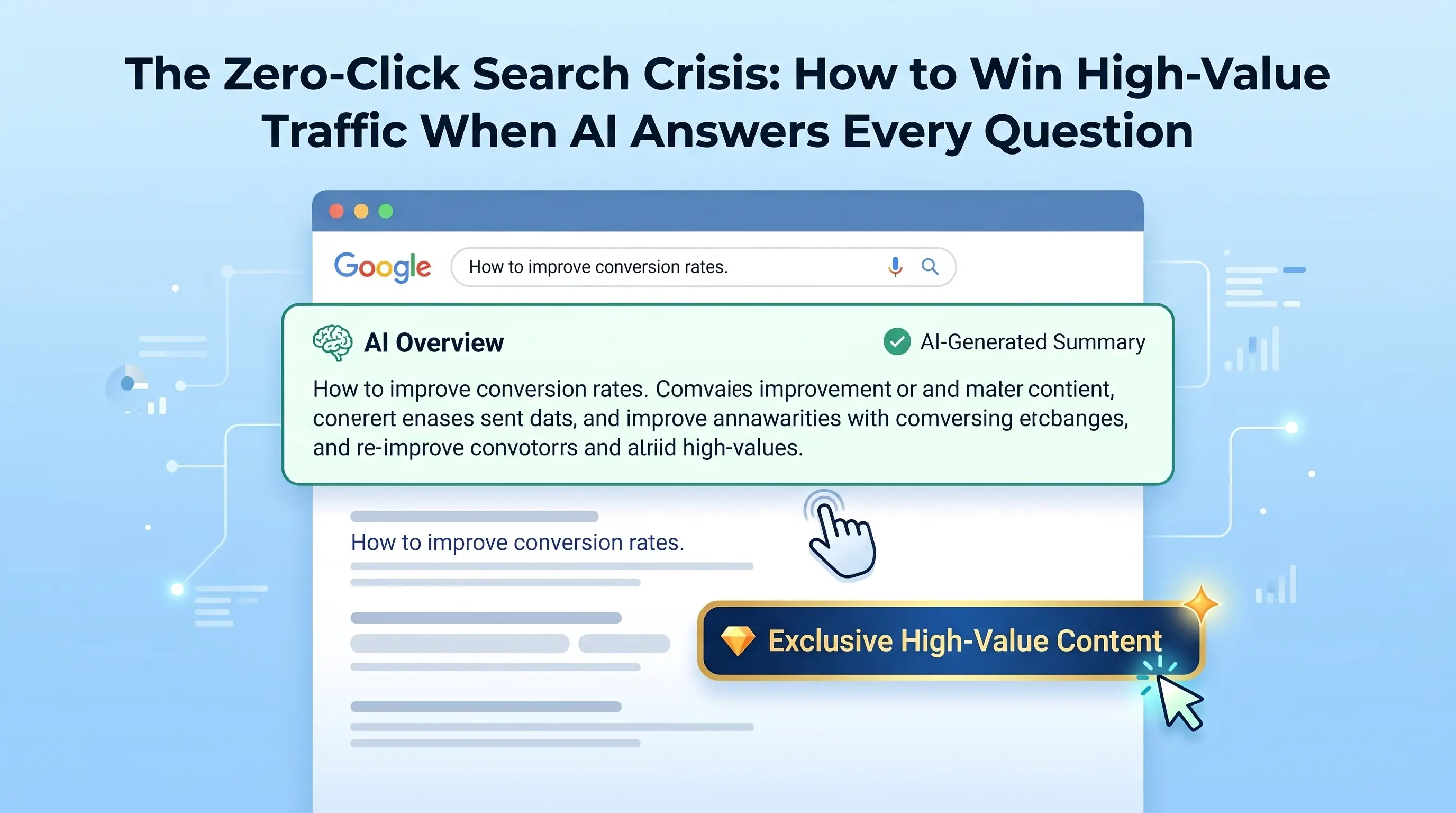
Quick Summary (GEO Answer): Zero-click search occurs when search engines and AI answer engines (Google AI Overviews, Perplexity, ChatGPT Search) synthesize complete answers directly in the query interface without sending visitors to underlying websites. To thrive in this environment, businesses must evolve from keyword-stuffed commodity articles to Generative Engine Optimization (GEO)—publishing high-information-gain content, structured entity knowledge graphs, proprietary data benchmarks, and agent-ready web architectures that AI models cite as authoritative sources.
The Death of the Traditional 10 Blue Links
For more than two decades, search engine optimization followed a predictable formula: research a high-volume keyword, write an 1,800-word explanatory article, build backlinks, and collect organic search clicks. That playbook is officially decaying in real time.
With the mainstream rollout of Google AI Overviews, Perplexity Pro, ChatGPT Search, and Gemini-powered SERPs, the search experience has shifted from a directory of links to an interactive synthesis engine. Industry studies show that over 60% of all search queries now resolve without a single click to an external domain.
If your website relies on answering top-of-funnel, definitional questions like 'what is headless commerce' or 'how does responsive web design work,' LLMs can now answer those questions instantly in 3 sentences. The user gets what they need, and your website receives zero impressions, zero visits, and zero pipeline value.
The Commodity Content Trap
The fundamental vulnerability of most business websites today is what we call the Commodity Content Trap. When companies churn out generic, AI-assisted blog posts rewritten from existing Wikipedia articles and competitor blogs, they create content with zero information gain.
Large Language Models thrive on ingesting this generic content during training, compressing it into probabilistic weights, and serving the distilled answer directly to searchers. When you publish commodity content, you are essentially training your replacement for free while eroding your direct organic inbound traffic.
Comparison: Traditional Keyword SEO vs. Answer Engine Optimization (GEO)
| Strategic Dimension | Traditional Keyword SEO | Generative Engine Optimization (GEO) |
|---|---|---|
| Primary Goal | Varies Rank on page 1 for target keywords | Elite Win direct LLM citations, entity inclusion & synthesized recommendations |
| Content Strategy | Moderate High-volume keyword blogs & generic FAQs | Elite Proprietary benchmarks, original case studies & high information gain |
| Data Architecture | Average Standard title tags & meta descriptions | Built-in Comprehensive JSON-LD entity graphs, schema markup & llms.txt endpoints |
| Traffic Profile | Red Declining top-of-funnel informational clicks | High High-intent buyers seeking specialized execution & verified expertise |
| Conversion Mechanism | Average Generic newsletter signups & gated PDFs | Total Control Interactive tools, live demos & verified case results |
4 Pillars to Win High-Value Citations in the Age of AI Search
While zero-click search hurts superficial traffic, it presents a massive arbitrage opportunity for serious digital brands. When an AI answer engine does cite a source, that citation carries immense authority and delivers buyers who are already in the evaluation phase of their purchase journey.
Here are the four strategic pillars we implement at Vantage Point to ensure our clients capture market share in AI-driven search ecosystems:
1. Engineer Maximum Information Gain
Information Gain is Google's patent-backed scoring metric that measures how much novel, non-redundant value a webpage adds beyond what is already known across the index. LLMs cite sources that offer new primary research, unique data points, concrete pricing breakdowns, or unconventional architectural frameworks.
If an AI cannot synthesize the answer from existing training data without your original testing or verified case numbers, it has no choice but to fetch, quote, and link back to your domain as the primary source.
2. Build Unambiguous Entity Knowledge Graphs
LLMs do not parse web pages like traditional keyword crawlers; they navigate connected conceptual entities. Your website must provide rich, machine-readable JSON-LD schemas (Organization, Service, TechArticle, CaseStudy, ItemList) that clearly define what your business does, whom you serve, and your verified track record.
When Google's Knowledge Graph and OpenAI's retrieval systems can cleanly connect your brand entity to your core specialties without ambiguity, your site becomes the canonical reference point for complex industry queries.
3. Implement Agent-Ready Web Standards (llms.txt & Fast Crawl)
Modern AI search engines like Perplexity and SearchGPT execute real-time web retrieval passes using headless browser workers and markdown parsers. If your web pages are bogged down by client-side JavaScript bloat, slow server response times, or paywalls, AI crawlers will time out and select a competitor.
Providing a clean /llms.txt route, maintaining sub-millisecond static edge responses via Cloudflare/Vercel, and keeping semantic HTML tags clean ensures AI bots ingest your structured arguments with zero parsing friction.
4. Shift From 'Educational' Traffic to 'Decision-Stage' Utility
Stop measuring the success of your digital presence by raw pageviews. The goal is no longer to get 50,000 students reading a basic tutorial; it is to get 50 venture-backed founders or marketing directors who see that your studio designs and engineers bespoke platforms that outclass off-the-shelf templates.
- Publish live, interactive tools and benchmarks rather than static definitions.
- Showcase transparent case breakdowns with real performance metrics, Lighthouse scores, and conversion uplifts.
- Integrate direct consultation pathways and clear service architecture.
- Maintain active crawler hints and instantaneous IndexNow batch submissions after every content release.
Future-Proof Your Brand's Digital Platform
The transition to AI answer engines does not mean the end of organic growth—it marks the end of low-effort content farming. Brands with exceptional digital craftsmanship, distinct viewpoints, and robust technical foundations will command higher trust and higher conversion rates than ever before.
At Vantage Point, we engineer high-performance web applications, modern design systems, and GEO-optimized platforms that help ambitious businesses dominate both human perception and autonomous AI search ecosystems.
Explore Our High-Performance Web Development ServicesMore From the Journal
Have a project in mind?
Tell us where you want the brand to go. We'll tell you how to get there.
Start a Project