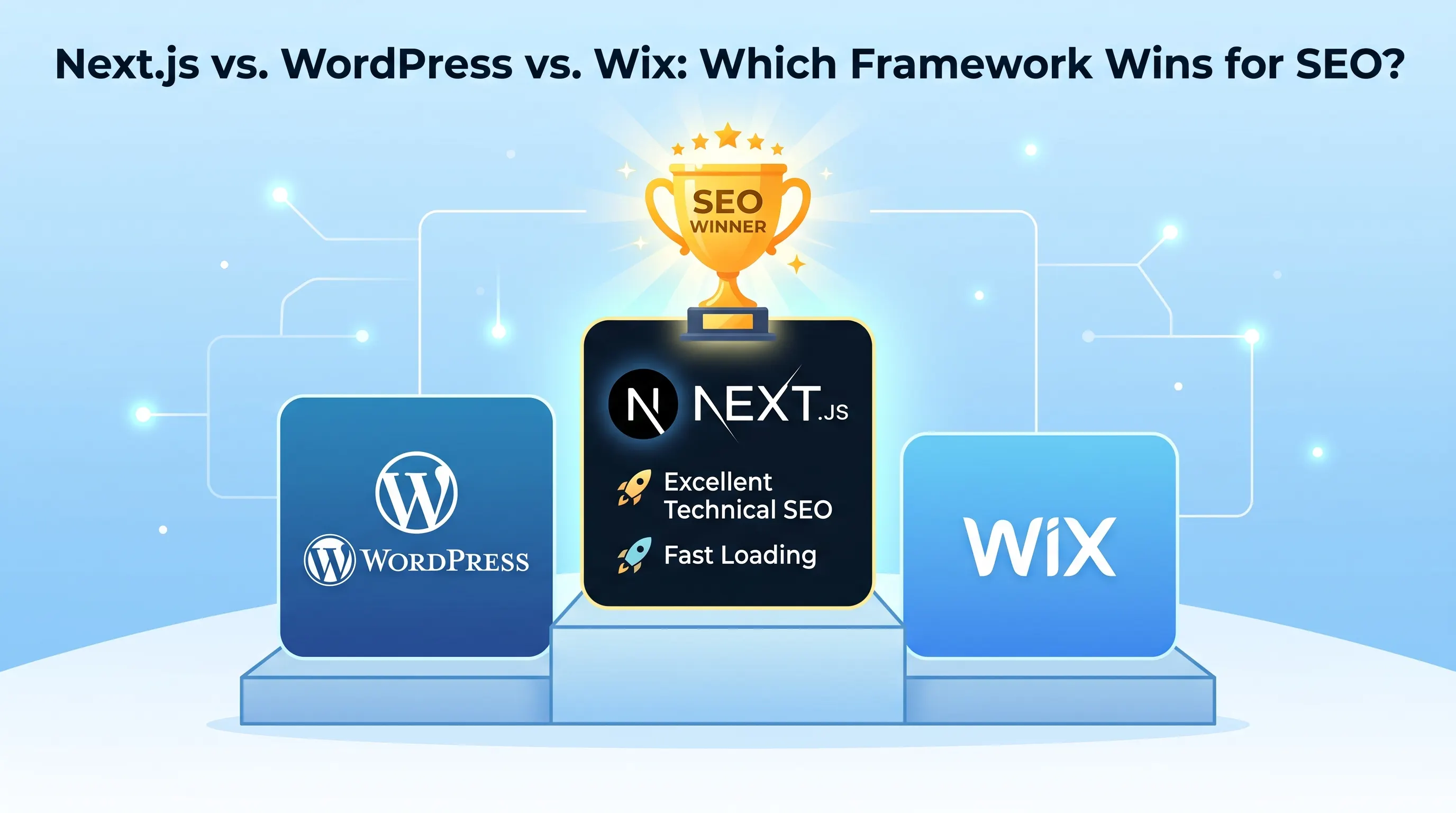
One of the most persistent debates in web development centers on platform choice and search engine rankings: does Google favor a specific technology stack?
The short answer is no. Google does not rank a website based on the brand of its framework. Search engines evaluate the final rendered HTML and practical user experience.
In practice, three pillars matter most:
- Core Web Vitals: loading speed, visual stability, and interactivity.
- Crawlability and technical architecture: clean sitemaps, semantic tags, metadata, and canonical structure.
- Content quality and backlink authority.
Google is platform-agnostic, but your stack determines how easily and how reliably you can sustain top technical performance over time.
Comparison Matrix
| Feature | Next.js | WordPress | Wix |
|---|---|---|---|
| Core Web Vitals (Speed and Stability) | Elite native SSR/SSG, image optimization, minimal bloat. | Varies requires strong caching and declines as plugins accumulate. | Average solid baseline optimization with limited deep tuning. |
| Initial SEO Setup Speed | Requires code developers implement sitemap, metadata, and canonicals. | Fast plugins like RankMath or Yoast configure essentials quickly. | Built-in visual controls for core SEO tags. |
| Technical Control and Customization | Total control JSON-LD, headers, code splitting, and rendering strategy. | Medium constrained by theme structure and PHP runtime overhead. | Restricted closed architecture with limited server-level control. |
| Long-Term Architectural Scaling | High ideal for custom web apps, API integrations, and complex systems. | Moderate excellent for editorial workflows, harder for software-like products. | Low difficult to scale beyond simple marketing websites. |
Deep Dive: The Strengths and Trade-Offs
1. Wix: Accessibility at the Expense of Control
Wix offers an all-in-one visual ecosystem that makes launching a basic web presence fast and accessible for non-technical users.
- The Advantage: Built-in SEO features cover foundational needs out of the box. Custom domains, basic meta descriptions, canonical tags, and automatic sitemap creation require no development work.
- The SEO Ceiling: Wix runs on a closed ecosystem. You cannot fine-tune server-side caching, deeply control JavaScript loading, or fully customize advanced schema strategies. In competitive niches, this can cap ranking potential.
2. WordPress: The Editorial Powerhouse
Powering a large share of the web, WordPress remains a leading platform for content publishing and editorial workflows.
- The Advantage: Setup speed. With plugins like Yoast SEO or RankMath, teams can configure canonicals, Open Graph metadata, and XML sitemaps quickly without writing code.
- The SEO Ceiling: Architectural bloat. Traditional WordPress relies on dynamic PHP rendering and database calls for each request. As plugins stack up, performance often degrades, especially on mobile, unless teams maintain strict caching and plugin discipline.
3. Next.js: The Technical SEO Powerhouse
Next.js takes a modern rendering-first approach with Static Site Generation (SSG) and Server-Side Rendering (SSR), delivering lightweight HTML through global CDNs.
- The Advantage: Speed and control. Pre-rendered HTML, automated image optimization, and JavaScript code splitting support excellent Core Web Vitals while enabling fully programmatic SEO and schema markup.
- The SEO Ceiling: Higher engineering lift up front. Unlike WordPress or Wix, a custom Next.js implementation requires developer setup for SEO primitives and often a headless CMS integration for editorial workflows.
The Verdict: Choosing the Right Tool for the Job
The best framework depends on business goals, team capabilities, and how much technical control the project requires.
- Choose Wix if you need a simple marketing site launched quickly with minimal maintenance and low technical overhead.
- Choose WordPress if your model depends on frequent editorial publishing, multi-author workflows, and non-technical content operations.
- Choose Next.js if you want top-tier performance, custom web application capability, excellent Core Web Vitals, and long-term architectural flexibility.
More From the Journal
Have a project in mind?
Tell us where you want the brand to go. We'll tell you how to get there.
Start a Project