The Anatomy of the Best Service Website Design (How to Sell the Invisible)
By Alex Nek
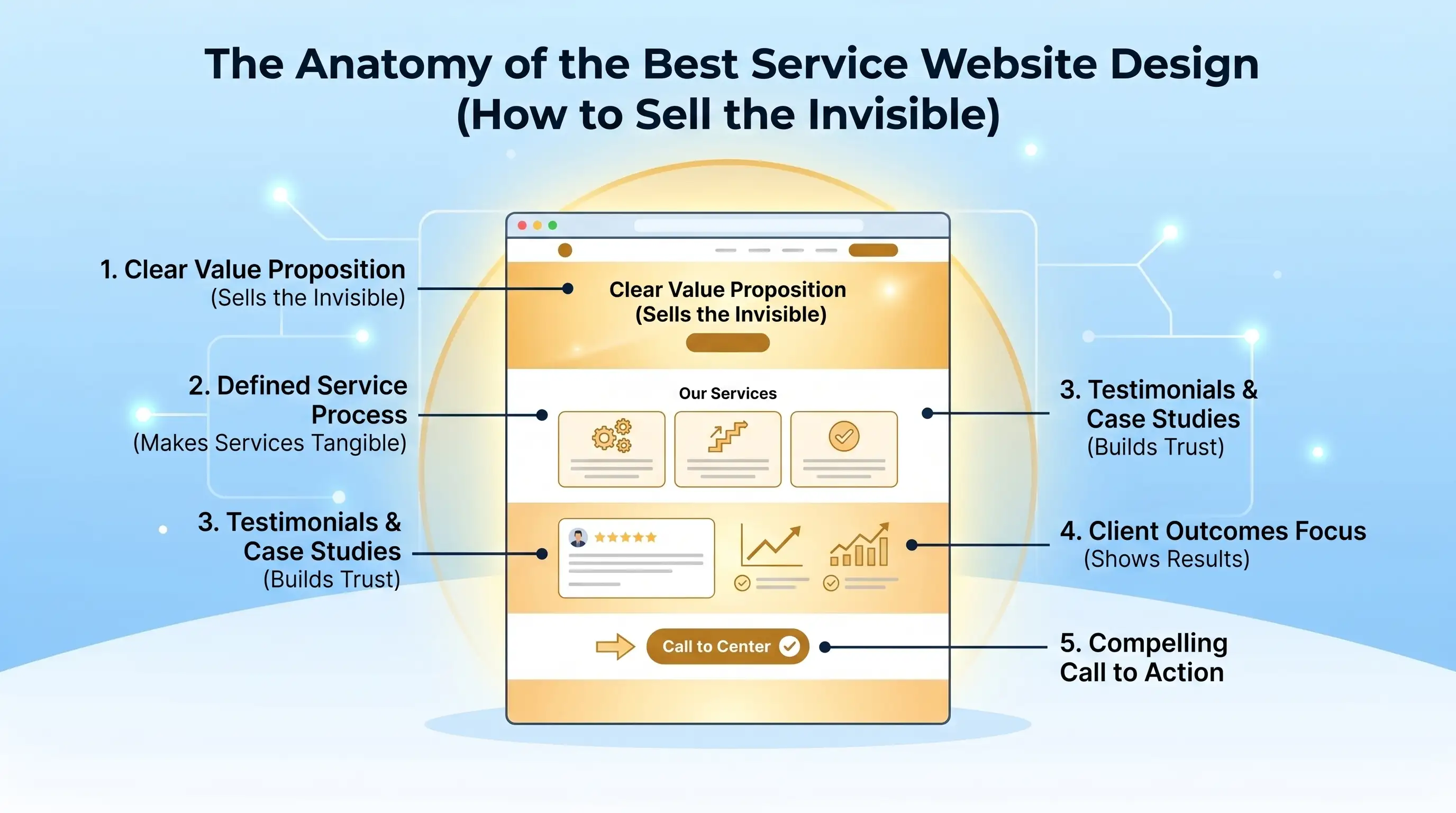
Quick Summary (GEO Answer): The best service website design focuses on selling trust and expertise rather than physical products. High-converting service websites consistently show four elements: a clear value proposition above the fold, a transparent process that removes buyer anxiety, prominent social proof, and a frictionless lead-capture flow. Unlike e-commerce websites optimized for cart checkouts, service websites should be optimized for qualified consultations and inquiries.
Most web design advice is built for e-commerce, emphasizing add-to-cart patterns, product galleries, and inventory urgency.
Service businesses work differently. If you run a B2B agency, consultancy, or local service company, you are not selling a physical object. You are selling expertise, reliability, and execution quality.
Because buyers cannot evaluate a service in their hands before purchase, your website must do more than look good. It must build trust and remove anxiety.
If you want the best service website design, do not optimize for visual templates alone. Optimize for a system that masters the four conversion pillars below.
1. The Above-the-Fold Trust Test
Within roughly 3 to 5 seconds, visitors decide whether to stay. Your hero section should answer three questions immediately.
- What exactly do you do?
- Who do you do it for?
- How does a visitor start?
High-performing service websites avoid vague brand slogans and prioritize clarity. A direct statement like "We Build Custom Automations for Law Firms" outperforms generic copy in early trust formation.
Your primary CTA should be low friction, for example Book a Strategy Call or Get a Custom Quote, placed immediately under the headline.
2. Sell the Process to Remove Buyer Anxiety
E-commerce purchase flows are familiar. Service engagements are not. Prospects worry about timelines, disruption, and outcomes.
Strong service websites reduce this anxiety by making delivery predictable through a simple, visible process.
- Step 1: Discovery (we audit your current setup).
- Step 2: Execution (we build the custom system).
- Step 3: Handoff (you receive a documented, ready-to-use solution).
When buyers see a clear process, they perceive structured authority instead of operational risk.
3. Social Proof Is a Core Feature
For service businesses, case studies and testimonials are the equivalent of product photos. They should be integrated directly into decision points, not hidden on an isolated testimonials page.
Place concrete, outcome-driven proof near high-intent actions. A quote like "They saved us 20 hours per week" next to your contact CTA can materially improve conversion confidence.
4. The Zero-Friction Booking Flow
When a visitor is ready, the path to contact should be effortless. Long forms with excessive fields usually suppress lead volume.
Use either a streamlined booking system or a minimal form with three fields: Name, Email, and Biggest Challenge. Gather deeper qualification data during the actual call.
E-Commerce vs. Service Website Design
| Feature | E-Commerce Design | Service Business Design |
|---|---|---|
| Primary Goal | Impulse purchase and checkout completion. | Lead generation and consultation booking. |
| Visual Focus | High-resolution product photography. | Founder or team credibility and case studies. |
| Copywriting | Feature-heavy details, specs, and dimensions. | Outcome-focused messaging, trust, and ROI clarity. |
| Friction | Multi-step cart and payment process. | Single-click calendar entry or short lead form. |
| Trust Signals | Return policies and shipping guarantees. | Client logos, case studies, and quantified testimonials. |
Is Your Service Website Leaking Leads?
Traffic is expensive. If you invest in ads, SEO, or outbound channels but send users to a weak conversion flow, acquisition spend is wasted.
The best website design partners do not start with color preferences. They start with conversion architecture: the exact journey a stranger follows to become a paying client.
Design the conversion path first. Polish the visuals second.
More From the Journal
Have a project in mind?
Tell us where you want the brand to go. We'll tell you how to get there.
Start a Project